
Celtic Design Guide
Exploring Celtic knotwork, crosses, Claddagh rings, and symbolism in art.
Knotwork Series: Part 1 — Origins | Part 2 — Continuum | Part 3 — Symbolism
Major Symbols: Celtic Cross | Claddagh Ring | Zoomorphic Animals
Related Content: What Does It Mean? | Key Patterns | Ancient Methods | Modern History 1840-1980
Celtic interlace designs make their first appearance in early Christian Celtic art in the middle of the seventh century A.D. These intricate knotwork patterns — the endless loops, the interwoven paths — are what most people recognize as "Celtic." But there is often confusion about what these designs mean, where they came from, and how they should be interpreted.
Origins of Celtic Knotwork
There are three objections that might be raised against the statement that Celtic interlace appeared in the seventh century. The first comes from scholars who would argue that the term "Celtic" is inappropriate. Margaret Stokes, writing in 1887, opens the preface of her book with these sentences: "The subject of the following chapters is what has been mis-labeled Celtic, Anglo-Saxon or Runic Art, whereas the style is Irish." The term "Celtic" belongs to the arts of bronze and gold and enamel practiced in Britain before Roman occupation. Had this proposal been followed, the label would leave out Pictish and Northumbrian schools of Celtic art.

Book of Kells, Canon Table (c. 800 A.D.) — key patterns alongside interlace
The second argument comes from those fascinated with pre-Christian Celtic culture. The interlace designs now called "Celtic" appeared in Irish art and areas associated with the early Irish church at least 200 years after Saint Patrick began his mission in 431 A.D. Calling artwork such as the Book of Kells (circa 800 A.D.) "Early Christian" uses the word "early" from the perspective of more than eleven hundred years later. Ireland had already begun her fourth century of Christianity.
Christian Origins, Not Pagan Roots
The interlace designs that are recognized as Celtic are early Christian. They appeared in the Insular style that emerged in Ireland, Scotland, and Northumbria in the seventh century. The La Tène style of spiral ornament dominated Celtic art until the interlace appeared. Even then the La Tène style did not die out — the two coexisted. What is significant is that by the eighth century, interlace was the defining characteristic of what art historians call the Insular style.
Read Part 1: Origins of Celtic Knotwork →
Symbolism and Meaning
The question most often asked about Celtic knotwork is: "What does it mean?" The assumption is that these designs are a secret language of symbols that could be decoded if only the key were found. But the historical reality is more complicated. Art historians are consumed with problems of timeline, place of origin, and migration of styles. When symbolism is attempted, scholars tend to be very cautious — citing obscure references in ways that make their text difficult to understand.
The Triquetra: A Case Study
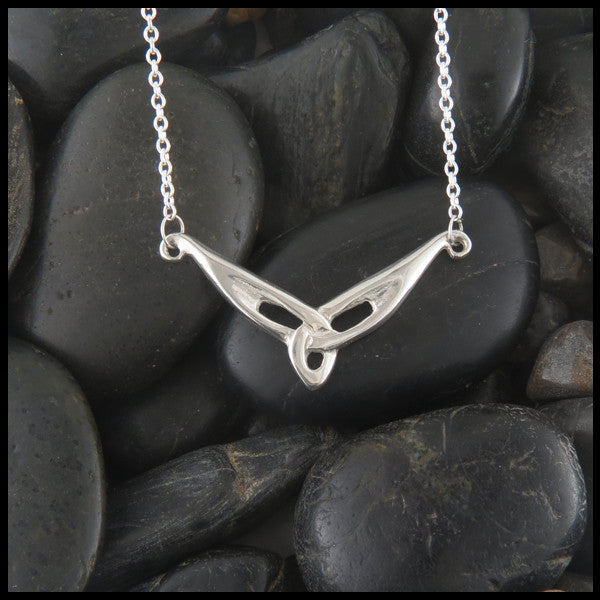
The triquetra, or three-fold knot, is a good example of the difficulty in assigning specific meaning to Celtic designs. Sacred numbers and the symbolism of numerology offer a promising basis for interpretation. The triquetra is an obvious sign of the Holy Trinity. Other knots could represent the four directions, the twelve Apostles. But as important as numbers are in Scripture, legends and poetry, the connection remains elusive and the evidence circumstantial.
J. Romilly Allen, writing in 1903, states that with the exception of instances at Meigle and at Llanfrynach in Brecknockshire, the triquetra is used for purely ornamental purposes, and there is not the least foundation for the theory that it is symbolic of the Holy Trinity. If the triquetra had ever any symbolic significance at all, it was probably in pagan times. Allen's premise seems based on the observation that the triquetra plays a decorative role and is not given the prominence of placement that one would assume an important symbol should have.
Read more: The Triquetra — What Does the Trinity Knot Really Mean? →
Read Part 3: In Search of Meaning — Symbolism →
The "Endless Path" Interpretation

George Bain Collection, Groam House Museum
A standard answer to the meaning of knotwork, offered by many craftsmen and artists in recent times, is that Celtic knots are endless paths and so represent eternity or continuum. The Scottish art teacher George Bain published a book in 1951 that became a standard reference. In it, the author made a great deal of the single continuous path laid out in many ancient knotwork panels. This observation leads to ideas about the "circle of life" or "never ending — love, faith, loyalty, whatever you want."
Many ancient Celtic knots are not a single path, but several closed paths that are linked or woven together. These can be seen as metaphors for the interwoven-ness of life. Linking knots are frequently referred to as "love knots."
Read more: Celtic Design — What Does It Mean? →
The Celtic Revival
With the Norman invasions of Britain and Ireland, Celtic design went into decline. Traditions of using interlace designs lingered in some of the more Gaelic areas. It eventually became a way of identifying with an older Gaelic cultural tradition in the face of advancing Anglo-Norman power. By the fifteenth century there was a self-conscious preservation of an older social order with a distinctly Celtic heritage.
Ireland
The Celtic Revival in Ireland began as an effort to restore a sense of pride in a distinct Irish culture. Objects such as the Book of Kells and the Tara Brooch were concrete evidence that the Irish had once been a sophisticated, civilized society. The reuse of Celtic designs began as imitations of historical jewelry and monuments used as an affirmation of Irish identity.
Scotland
During the same time, Queen Victoria was an enthusiastic promoter of a romantic vision of Scottish national identity. Celtic design was slow to catch on in Scotland. Victorian dirks were carved with thistles and clan emblems, rather than traditional interlace. It was later in the nineteenth century that knotwork began to add ornaments to tartan. The trend towards Celtic design on Highland dress accessories has slowly but steadily increased to the present.
The earliest Celtic Revival monuments are from the 1860s. In both Scotland and Ireland, monumental carving was and remains the most conspicuous uses of Celtic design. Many of the most elaborate earlier monuments of the Celtic Revival are gravestones of priests. Recognition of the legacy of the Celtic Church was being expressed with the creation of new "High Crosses" both as public monuments and as grave markers.
Read more: The Modern History of Celtic Jewellery: 1840-1980 →
The Celtic Cross
The question of what the Celtic cross means is one that is often asked. As a craftsman and jewelry designer in the Celtic tradition, the answer is not as straightforward as one might hope. The history of this powerful symbol is ambiguous. There are many variations of interpretations and legends about the original meaning that are commonly repeated even today. The Presbyterian and Catholic are often startled to learn that the other considers this symbol their own. In the modern multicultural world, the ringed cross is as much a symbol of ethnic heritage as it is of faith.

Christian and Pagan Interpretations
The Irish Catholic priest will have no hesitation telling visitors that the circle of the Celtic cross is a symbol of eternity that emphasizes the endlessness of God's love as shown through Christ's sacrifice on the cross. That is unless he says the circle is a halo. He may go on to explain that the crucifixion is important not just as an event at a certain point in time but, as the circle symbolizes, as an unending mystery of how through the crucifixion and resurrection Christ continues to offer the hope of salvation to the faithful throughout all time.
At the pub, one might just as likely hear the explanation that great stone Celtic crosses were carved from standing stones of Druids and were originally phallic symbols. No proof of this theory is offered. There are also New Age interpretations about how the cross in the circle is a symbol of the sun that was worshipped by Druids and that this symbol was appropriated by Christians. Born Again Pagans are enthusiastic about Celtic designs and are successfully appropriating Christian symbols back to their supposed primal meaning.
George Bain, in the preface to his excellent book on Celtic art, wrote the following about meaning: "After consultation with an eminent prehistorical Archaeologist, his advice was to publish meanings that evidence suggested was accepted, with the qualification that if others could bring evidence to prove other meanings, agreement to such would benefit truth." That statement sounds sensible enough but it is neither followed nor preceded by more than the vaguest of hints of what the original communicative purpose might have been.
What these crosses mean to viewers today and what they meant when Christianity was new to Celtic Britain and Ireland are in some ways the same and in some ways different. The cross, either vertical or diagonal with equal-length arms, is a universal mark. It is so primal that it exists in all cultures as does the circle. There are no human cultures that have no art or symbols and there are no systems of symbols that do not include circles and crosses. These marks are opposites. The circle contains and is unending while the cross both reaches out and marks a specific, finite point at center. Contemplating this yields many possibilities and in this way the designer or the viewer can find personal meanings.
Read more: Celtic Cross History & Symbolism →
The Claddagh Ring
The Claddagh ring, with its heart, crown, and hands, is one of the most recognized symbols of Celtic heritage. The story begins in Galway, Ireland, in the seventeenth century. Richard Joyce, a Galway man captured by Algerian corsairs around 1675, was enslaved and purchased by a Moorish goldsmith who trained him in the craft. When King William III sent an ambassador to Algeria demanding the release of British subjects held there, Joyce was freed in 1689 and returned to Galway — where the earliest reliably dated Claddagh rings bear his maker's mark. The ring design he brought back became the model for what would become an enduring Irish tradition.

The Meaning: Heart, Crown, Hands
The heart represents love. The crown represents loyalty. The hands represent friendship. When the ring is worn on the right hand with the heart pointing outward, away from the wearer, it signifies that the person is open to love. On the left hand, with the heart pointing inward toward the wearer, it tells the world that love has been found. These are the traditional meanings that have been passed down through generations in Galway and beyond.
Read more: Claddagh Ring History & Meaning →
Zoomorphic Animal Designs

Animal imagery appears throughout Celtic art — birds intertwined in knotwork, beasts interlacing with patterns, creatures peering from carved borders. Fantastic animals with limbs, bodies, tongues and tails looped and tangled together are a great part of the tradition. Their symbolism draws on medieval bestiaries and Celtic legend: dogs represent loyalty, truth through keen perception, and healing; eagles are esteemed for their power and especially the acute vision of their eyes; the Salmon of Knowledge represents wisdom. Celtic legends — the Hound of Cuchulain, the water kelpies, Saint Columba and the Heron — kept zoomorphic designs alive through the Celtic Revival to today.
Read more: Zoomorphic Celtic Symbolism →
Celtic and Pictish Key Patterns

The Maiden Stone, Aberdeenshire — key patterns carved in Pictish stone
Beyond knotwork, Celtic art includes another style of ornament that is sometimes overlooked: key patterns. These are angular, rectilinear designs that share the characteristic of Celtic interlace — continuous movement without beginning or end — but they move in straight lines and sharp angles rather than flowing curves. Key patterns are found in both Irish and Pictish art, representing a different approach to the same underlying principle of continuous movement.
Rectilinear Movement
Key patterns are geometric — straight lines, right angles, step-like progression. They lack the organic flow of knotwork but compensate with complexity of pattern and precision of execution.
Continuous Unbroken
Like knotwork, key patterns never break — the line continues, turns, and connects without interruption. This shared quality of endless movement is what ties Celtic ornament together.

Key pattern drawing by A. Gibb, from Sculpted Stones of Scotland (John Stuart, 1867)
Read more: Celtic and Pictish Key Patterns →
The Geometry Behind Celtic Metalwork
The mind-boggling complexity of the great masterpieces of Celtic metalwork — the Tara Brooch, the Ardagh Chalice, the Cross of Cong — were created with even less than basic tools. Goldsmiths had to make their own wire. Casting was done with charcoal-fired foundries. Molds were fashioned without the benefit of commercially engineered materials. What made these marvels possible was geometry: designs and layouts constructed using compass and straight edge can be found underlying Insular art in stone, metal, and on vellum.

Casting from a carved mold — recreating early medieval methods

St. Ninian's Isle piece — cast from a hand-carved mold
Kerbschnitt: Chip-Carved Casting
The kerbschnitt, or chip-carved, designs cast into high-status metalwork have long fascinated craftsmen. The late Robert Stevick documented the coherent geometry — the compass-and-straightedge constructions — underlying Insular art across manuscripts, stone carving, and metalwork. What his work revealed is that the same geometric system governed the layout of penannular brooches from the late seventh to ninth centuries. The compass was not only a drawing instrument; it could be modified into a carving tool, essential to how kerbschnitt-style cast metalwork was created.
Sometime after masterpieces like the Tara Brooch were made circa 750 A.D., some of the skills used to produce them were lost. Reconstructing those methods — experimenting with mold-making as it was practiced in early medieval times — is the work of decades, not months. Published research on the St. Ninian's Isle Treasure, the Ardagh Chalice, and the Cross of Cong has brought a craftsman's perspective to what had been purely art-historical questions.
Read more: Coherent Geometry — Carved Molds and Ancient Methods →
Wear Celtic Artistry
Each piece created at Walker Metalsmiths carries forward the tradition of Celtic artistry. From intricate trinity knots to ornate Celtic crosses, every design honors the legacy that has evolved from the seventh century to today.
Three-fold designs
Ringed designs
Love & loyalty
Animal designs
Knot & band designs
Celtic & Irish
Cuffs & bangles
Explore More Celtic Design & History
- Celtic Interlace Part 1 — Origins of Celtic knotwork (7th century)
- Celtic Interlace Part 2 — The continuum of Celtic art
- Celtic Knotwork Meanings — Understanding ancient Celtic designs
- Celtic Design: What Does It Mean? — Questions about symbolism
- Celtic & Pictish Key Patterns — Geometric Celtic designs
- The Modern History of Celtic Jewellery — Celtic Revival and beyond
- History of the Luckenbooth Brooch — Scottish heart design
- George Bain Hunting Rug at Walker Metalsmiths — Pictish art and the Celtic Revival scholar
- Celtic Art: The Local Tradition — Regional roots of Celtic design
- Coherent Geometry: Carved Molds & Ancient Methods — Kerbschnitt technique and compass geometry behind the Tara Brooch and Ardagh Chalice

About Stephen Walker
Stephen Walker is founder and Master Craftsman at Walker Metalsmiths. With decades of study in Celtic art history and hands-on experience creating traditional designs, Stephen brings both scholarly knowledge and artistic practice to understanding Celtic symbolism. He is co-author of The Modern History of Celtic Jewellery: 1840-1980 and serves on the advisory panel for the George Bain Collection at Groam House Museum, Scotland.
Note on historical accuracy: When discussing Celtic history and symbolism, the writing draws from primary sources — manuscripts, stone monuments, and surviving artifacts. Where the historical record is silent, distinctions are made carefully between documented fact and the rich folklore that has grown up around these designs over centuries.
Learn more about Stephen & Susan Walker →
Read Stephen's book: "The Modern History of Celtic Jewelry" →
© Stephen Walker, Walker Metalsmiths. All rights reserved.

