
History of the Luckenbooth Brooch
History of the Luckenbooth Brooch
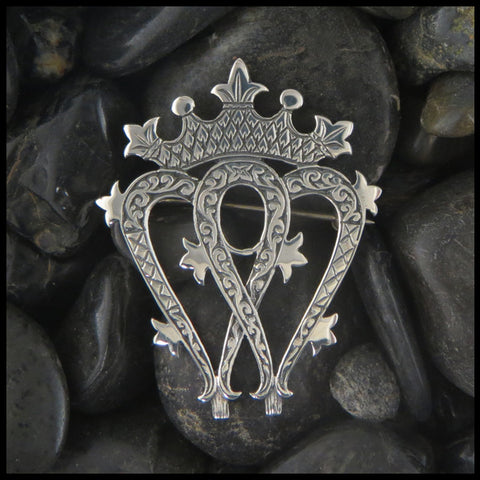
The Luckenbooth brooch gains its name from the "locked booths" that sold trifles along the Royal Mile near Saint Giles Cathedral in High Street, Edinburgh. This romantic Scottish brooch has been treasured for centuries as a love token and protective talisman.
Design and Variations
In its simplest form it is a single heart shape with an open center that works with a buckle pin like an annular brooch. The heart and crown motifs are part of the same 17th century fashion trends that resulted in the Claddagh ring design in Ireland. Two hearts intertwined; with and without crowns, as well as various abstractions and embellishments give this quite simple type of brooch many delightful forms.

Symbolism and Folklore
Quite commonly given as a love token or betrothal gift, folklore also invests the Luckenbooth brooch with talismanic value for protection against evil-eye and for nursing mothers to avoid witches stealing their milk or harming their babies. Legend associates the Luckenbooth brooch with Mary Queen of Scots (1542-1587). The form with two hearts and crown can be read as a romantic abstraction of the letter "M" in a royal monogram.
Romantic Symbolism
Like the Irish Claddagh ring, the Luckenbooth brooch combines heart and crown motifs to represent love and loyalty. Both designs emerged from the same 17th century tradition of romantic jewelry with symbolic meaning.
Cultural Reach Beyond Scotland
Surprisingly, silver Luckenbooth brooches were a popular trade item with American Indians in the 18th century, especially the Iroquois Nations. The design remains a traditional jewelry accessory and is even called "Luckenbooth" by contemporary Native-Americans.

Victorian Revival and Modern Tradition
The Luckenbooth brooch has been a self-consciously Scottish form of jewellery since the 19th century. The form was adapted to pebble jewellery in Victorian times, as well as being a regular feature in the ranges of most Scottish manufacturing jewellers who worked for the Highland outfitter and tourist trades.
From The Modern History of Celtic Jewellery: 1840-1980 by Stephen Walker, Aidan Breen, Tara Kelly, and E. Mairi MacArthur
Shop Luckenbooth Brooches & Scottish Jewelry
Discover our handcrafted Luckenbooth brooches and other traditional Scottish Celtic jewelry designs.
Browse Celtic Brooches → Claddagh Rings →Explore More Scottish & Celtic Traditions
- Claddagh Ring History and Symbolism — Discover the Irish cousin of the Luckenbooth brooch
- Antique Irish and Scottish Jewelry Exhibit — Victorian Celtic Revival brooches and Scottish jewelry traditions
- The Modern History of Celtic Jewellery: 1840-1980 — Learn about 19th century Scottish jewelry manufacturing
- Celtic Brooches & Pins Collection — Shop traditional Scottish and Irish brooches
- About Stephen & Susan Walker — Meet the Celtic jewelry historians and craftspeople

About the Author
Stephen Walker has been handcrafting Celtic jewelry in Andover, NY since 1984. His extensive research into Scottish and Irish jewelry traditions led him to co-author The Modern History of Celtic Jewellery, which explores the Victorian revival of traditional forms like the Luckenbooth brooch.
Comments on this post (3)
Is this brooch the same idea? It has one heart, crown and thistle.
https://photos.app.goo.gl/x5sd9VgKk3egu9cQ6
— MichealSchupbach
I would sincerely love to obtain your book~The Modern History of Celtic Jewellery. Is there anywhere I could purchase it?
Thank you,
Loti Derewitz
( a Walkers Celtic Jewelry Customer).
— Lori Derewitz
hello, a friend would liketo have this description of Luckenbooth, becauseanotherfriend may own one.will you help?thanks. judith miles williamstown vt
— judith miles