Many years ago my wife's relatives organized a family reunion. The invitations were festooned with green clip-art shamrocks. Even though the gathering was a picnic in the summer, the party decorations had a sort of Saint Patrick's Day theme. As a professional designer craftsman who specializes in Celtic art, I was disappointed with what I was perceiving as a kitschy portrayal of the American family's Irish roots.
Let's face it, much of the green-beer revelry and kiss-me-I'm-Irish plastic vulgarities that come out around the middle of March every year are hardly consistent with the sophistication of such great masterpieces of Celtic heritage as the Book of Kells or the Tara Brooch. This is the Celtic identity that I embraced.
In the late 1960s, when I first was exposed to the medieval tradition of interlaced and complex geometric abstractions that are known as Celtic art, it was special, rare and exotic. Those that I met who recognized and displayed Celtic art seemed to me to have more sophisticated expression of Irish heritage than the shamrock people. It was the same with Irish music. The popular toora-loora-loora songs and Vaudeville Irish ditties had become the stereotypes of the American Irish identity. I was far more impressed by traditionalist musicians such as The Chieftains.
Six years in art school had made me something of a snob. The shamrock motif seemed to me low brow. But there is obviously something to it. Maybe it was just overdone. My own use of interlaced designs, spirals and key patterns, though rarely encountered in mainstream culture before around 1990, have become far more common in recent years. The Celtic knot-work that was rare in modern decorative arts during my youth is now so mainstream that you will see it on the Saint Patrick's Day tee shirts on sale at Walmart. So much for my highbrow Celtic motifs!
Sterling Silver St. Patrick's Cross
Authentic Irish symbols crafted with the same care as medieval masterpieces. Each piece honors both traditional heritage and artistic excellence.
In modern Ireland, shamrocks are rarely encountered as a banner at someone's home, as you so often see in America. Shamrocks in Ireland are usually facing the tourist's gaze, quite likely pandering to the appetite for symbols of Irish identity sought out by the Irish-American tourists. Look a little deeper and you will see many surviving shamrocks on monuments and decorating antiques from the nineteenth and early twentieth centuries. This was the period of the largest emigration out of Ireland, and into America. Apparently, a century ago in Ireland, the shamrock was used in a popular way much more than today. As I realized this my prejudice against the shamrock as a kitsch began to lose confidence.
My adventures have taken me on frequent trips to Ireland where I have met and become friends with some excellent Celtic artists and craftsmen. Aidan Breen, a Dublin based silversmith, is held in high esteem by his countrymen. His reputation as one of the leading designer craftsmen working in the Celtic genre has landed his work in such high-status collections as the Company of Goldsmiths permanent exhibit at Dublin Castle and the National Museum of Ireland. Aidan Breen has made some exquisite shamrock themed jewelry. If shamrocks are good enough for him, why should I hold back?
Aidan told me, "It is a particular type that looks down on the Shamrock, probably because it's popular with the majority of ordinary people. Everyone I know wears the Shamrock on Saint Patrick's Day. It also adorns the jersey of both the Irish soccer and rugby teams. It is a symbol the crosses the sectarian divide."
Celtic Shamrock Cross with Gemstones
Between visiting museums, reading, attending lectures and conferences, I have gained a better understanding and appreciation for how and why the shamrock has emerged as such a powerful symbol of Irish identity. A coin introduced in 1641 is the earliest surviving artistic illustration associating Saint Patrick using the three leafed shamrock. The Saint Patrick's copper illustrates the Ireland's patron saint explaining the Christian mystery of the Holy Trinity with a shamrock. The story was certainly already well known before this half penny coin was issued. The robed Patrick, with his bishop's crosier and miter, holds high a shamrock that is proportionally as large as his head. Patrick stands before a crowd receiving his teaching with Dublin coat of arms crowded into the tight composition.

St. Patrick's Copper Half Penny Coin, circa 1641
The shamrock, and the color green, emerged as symbols if Irishness in military regalia, both among Irish regiments fighting for the British Crown and among rebel movements. Irish soldiers serving in the British army organized a Saint Patrick's Day parade in New York in 1761. The rebel Society of United Irishmen, whose fight for independence failed in 1798, rallied under a green flag emblazoned with an Irish harp, they also used the shamrock among their symbols. The harsh treatment of the United Irishmen after their defeat was popularly recalled in the ballad, Wearing of the Green, which laments "they are hanging men and women for the wearing of the green."
From shamrocks to Claddagh rings and Celtic crosses, explore symbols that carry centuries of Irish history.
Fast forward to the Potato Famine of the 1840s. Nationalism dominated Irish thought as the desire for independence increased. In the decades following the great tragedy of the famine the restoration of a sense of Irish national identity became something of a cult. In the applied arts several motifs became emblematic of Ireland: the harp, the wolfhound, round towers, the Celtic cross, and the shamrock.
Of the millions of Irish who left Ireland, some fled to avoid prosecution for their nationalist politics, while most were driven out by hunger. Regardless of their reasons for leaving, a patriotic sense of Irish identity was strong among the exiles and carried on through the generations of their descendants. The song, the Wearing of the Green continued to be popular, but in America no one was being hanged for it. Among the poor Irish immigrants and their offspring, the only green they might afford to wear on Saint Patrick's Day might be as simple as a green paper shamrock pinned to the lapel. The paper shamrocks that may seem today like trite, nostalgic cultural appropriations are in fact a survival in folk memory of an authentic and powerful emblem of heritage, a reminder of past suffering and a joyful celebration of belonging.
New design 2021 Shamrock Heart Knot Pendant
It has been nearly twenty years since I shed my aversion to shamrockery. I am convinced that the shamrockery of the American descendants of Irish immigrants preserves something from an earlier time. I no longer cringe when I see the over-the-top get-ups at festivals and parades. Some of the relatives at that family reunion now own, and hopefully treasure, shamrock jewelry that I designed and made. If any of you are reading this, please forgive my arrogance. You were right and I didn't get it. Embrace the shamrock!

Stephen Walker is the founder and Master Craftsman at Walker Metalsmiths. With over 40 years of experience in Celtic design, Stephen has traveled extensively throughout Ireland and Scotland, studying ancient Celtic art and building relationships with traditional craftsmen. His work is informed by rigorous historical research combined with masterful metalworking technique.
Original designs © Stephen Walker
Continue reading
The ancient Celts excelled at metalwork. Archaeology has uncovered amazing artistic jewelry and weapons from the distant past that is proof of the skill, imagination and cultural sophistication of the ancestors of the modern Irish, Scots and Welsh. Many of these objects, such as the famed “Tara” brooch, have become emblems of national identity in the Celtic homelands and badges of ethnic pride among immigrants and their descendants.
In honor of Saint Patrick’s Day, Walker Metalsmiths of Andover will present a free exhibit of antique Celtic jewelry at their newly remodeled Main Street showroom. The collection of jewelry on display will include Victorian Celtic Revival examples from both Ireland and Scotland from the late 1800s into the early 1900s.
In the years when Ireland was recovering from the Potato Famine there was a renewed interest in the cultural past of that nation as well as a budding interest in archaeology. The discovery of the splendid early medieval “Tara” brooch in 1850 sparked an enormous enthusiasm for the style of Ireland’s Celtic past. By 1851 Dublin jewelers were crafting reproductions of the “Tara” as well as many other medieval brooches.

Royal Tara Brooch by Waterhouse & Co. Dublin circa 1850
We are pleased to be showing an example of the Tara Brooch manufactured by the Dublin firm of Waterhouse & Co. This reproduction of the 8th century original was named ‘The Royal Tara Brooch’ after Queen Victoria purchased two of them from Waterhouse at the Crystal Palace Exhibition in 1851.

By the time of the Irish uprising of 1916 the Tara brooch had become a national emblem. The reproductions once favored by the British Royal family were then part of the regalia of the rebels. Cumann na mBan the women’s auxiliary of the anti-British Irish Volunteers wore Tara style brooches with their parade uniforms. The exhibit includes a modernized enamel version of the Tara brooch in the colors of the Republican Irish flag that was a badge of Cumann na mBan after the War of Independence.

Also on exhibit is a medal and certificate in Celtic design that was awarded to one of Michael Collin’s men from the Irish War of Independence. William Doran, the father of legendary Hornell, NY radio broadcaster Kevin Doran, fought from 1918 to 1921. The materials are on loan from the Doran family.

On the Scottish side of the exhibit Scotch pebble jewelry is represented. This silver mounted style of agate and semi-precious gem jewelry often followed the shapes and forms of older Celtic and medieval styles and became very popular with the rise of middle class tourism in 19th century Scotland. Kilt accessories, including jeweled knives decorated with Celtic ornament are also on exhibit.

We published a companion book to the exhibit titled The Modern History of Celtic Jewelry. Although I am a modern Celtic jeweler myself this is not a book about my work. It is an account of the several generations that preceded me. The book is co-authored by Tara Kelly, a Trinity College art history scholar and expert on Victorian Celtic jewelry, E. Mairi MacArthur, a Scottish historian who has done extensive research into the careers of Alexander and Euphemia Ritchie, Celtic designers on the Isle of Iona and the Dublin silversmith Aidan Breen who is himself a living bridge between the Celtic Revival of the early 20th century and the present.
The exhibit will remain on display at Walker Metalsmiths for the remainder of the month of March 2016 and remain on view for the Andover Maple Festival April 2.
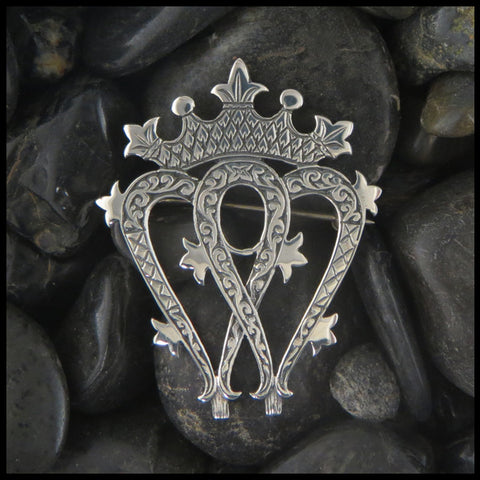
Continue readingThe Luckenbooth brooch gains its name from the “locked booths” that sold trifles along the Royal Mile near Saint Giles Cathedral in High Street, Edinburgh. In its simplest form it is a single heart shape with an open center that works with a buckle pin like an annular brooch. The heart and crown motifs are part of the same 17th century fashion trends that resulted in the Claddagh ring design in Ireland. Two hearts intertwined; with and without crowns, as well as various abstractions and embellishments give this quite simple type of brooch many delightful forms.

Quite commonly given as a love token or betrothal gift, folklore also invests the Luckenbooth brooch with talismanic value for protection against evil-eye and for nursing mothers to avoid witches stealing their milk or harming their babies. Legend associates the Luckenbooth brooch with Mary Queen of Scots (1542-1587). The form with two hearts and crown can be read as a romantic abstraction of the letter “M” in a royal monogram. Surprisingly, silver Luckenbooth brooches were a popular trade item with American Indians in the 18th century, especially the Iroquois Nations. The design remains a traditional jewelry accessory and is even called “Luckenbooth” by contemporary Native-Americans.

The Luckenbooth brooch has been a self-consciously Scottish form of jewellery since the 19th century. The form was adapted to pebble jewellery in Victorian times, as well as being a regular feature in the ranges of most Scottish manufacturing jewellers who worked for the Highland outfitter and tourist trades.
Continue reading