
History of the Luckenbooth Brooch

The Luckenbooth brooch gains its name from the “locked booths” that sold trifles along the Royal Mile near Saint Giles Cathedral in High Street, Edinburgh. In its simplest form it is a single heart shape with an open center that works with a buckle pin like an annular brooch. The heart and crown motifs are part of the same 17th century fashion trends that resulted in the Claddagh ring design in Ireland. Two hearts intertwined; with and without crowns, as well as various abstractions and embellishments give this quite simple type of brooch many delightful forms.

Quite commonly given as a love token or betrothal gift, folklore also invests the Luckenbooth brooch with talismanic value for protection against evil-eye and for nursing mothers to avoid witches stealing their milk or harming their babies. Legend associates the Luckenbooth brooch with Mary Queen of Scots (1542-1587). The form with two hearts and crown can be read as a romantic abstraction of the letter “M” in a royal monogram. Surprisingly, silver Luckenbooth brooches were a popular trade item with American Indians in the 18th century, especially the Iroquois Nations. The design remains a traditional jewelry accessory and is even called “Luckenbooth” by contemporary Native-Americans.
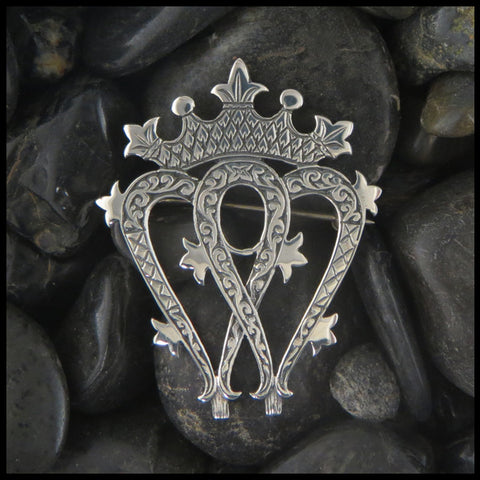
The Luckenbooth brooch has been a self-consciously Scottish form of jewellery since the 19th century. The form was adapted to pebble jewellery in Victorian times, as well as being a regular feature in the ranges of most Scottish manufacturing jewellers who worked for the Highland outfitter and tourist trades.
Continue reading