Walker Metalsmiths Blog

Embracing Shamrockery

Embracing Shamrockery

Many years ago my wife's relatives organized a family reunion. The invitations were festooned with green clip-art shamrocks. Even though the gathering was a picnic in the summer, the party decorations had a sort of Saint Patrick's Day theme. As a professional designer craftsman who specializes in Celtic art, I was disappointed with what I was perceiving as a kitschy portrayal of the American family's Irish roots.

Let's face it, much of the green-beer revelry and kiss-me-I'm-Irish plastic vulgarities that come out around the middle of March every year are hardly consistent with the sophistication of such great masterpieces of Celtic heritage as the Book of Kells or the Tara Brooch. This is the Celtic identity that I embraced.

In the late 1960s, when I first was exposed to the medieval tradition of interlaced and complex geometric abstractions that are known as Celtic art, it was special, rare and exotic. Those that I met who recognized and displayed Celtic art seemed to me to have more sophisticated expression of Irish heritage than the shamrock people. It was the same with Irish music. The popular toora-loora-loora songs and Vaudeville Irish ditties had become the stereotypes of the American Irish identity. I was far more impressed by traditionalist musicians such as The Chieftains.

Six years in art school had made me something of a snob. The shamrock motif seemed to me low brow. But there is obviously something to it. Maybe it was just overdone. My own use of interlaced designs, spirals and key patterns, though rarely encountered in mainstream culture before around 1990, have become far more common in recent years. The Celtic knot-work that was rare in modern decorative arts during my youth is now so mainstream that you will see it on the Saint Patrick's Day tee shirts on sale at Walmart. So much for my highbrow Celtic motifs!

Sterling Silver St. Patrick's Cross with shamrock

Sterling Silver St. Patrick's Cross

Handcrafted Shamrock Jewelry

Authentic Irish symbols crafted with the same care as medieval masterpieces. Each piece honors both traditional heritage and artistic excellence.

Shamrock Pendants → Shamrock Crosses → Shamrock Earrings →

In modern Ireland, shamrocks are rarely encountered as a banner at someone's home, as you so often see in America. Shamrocks in Ireland are usually facing the tourist's gaze, quite likely pandering to the appetite for symbols of Irish identity sought out by the Irish-American tourists. Look a little deeper and you will see many surviving shamrocks on monuments and decorating antiques from the nineteenth and early twentieth centuries. This was the period of the largest emigration out of Ireland, and into America. Apparently, a century ago in Ireland, the shamrock was used in a popular way much more than today. As I realized this my prejudice against the shamrock as a kitsch began to lose confidence.

My adventures have taken me on frequent trips to Ireland where I have met and become friends with some excellent Celtic artists and craftsmen. Aidan Breen, a Dublin based silversmith, is held in high esteem by his countrymen. His reputation as one of the leading designer craftsmen working in the Celtic genre has landed his work in such high-status collections as the Company of Goldsmiths permanent exhibit at Dublin Castle and the National Museum of Ireland. Aidan Breen has made some exquisite shamrock themed jewelry. If shamrocks are good enough for him, why should I hold back?

Aidan told me, "It is a particular type that looks down on the Shamrock, probably because it's popular with the majority of ordinary people. Everyone I know wears the Shamrock on Saint Patrick's Day. It also adorns the jersey of both the Irish soccer and rugby teams. It is a symbol the crosses the sectarian divide."

Celtic Shamrock Cross with gemstones in gold

Celtic Shamrock Cross with Gemstones

The History Behind the Symbol

Between visiting museums, reading, attending lectures and conferences, I have gained a better understanding and appreciation for how and why the shamrock has emerged as such a powerful symbol of Irish identity. A coin introduced in 1641 is the earliest surviving artistic illustration associating Saint Patrick using the three leafed shamrock. The Saint Patrick's copper illustrates the Ireland's patron saint explaining the Christian mystery of the Holy Trinity with a shamrock. The story was certainly already well known before this half penny coin was issued. The robed Patrick, with his bishop's crosier and miter, holds high a shamrock that is proportionally as large as his head. Patrick stands before a crowd receiving his teaching with Dublin coat of arms crowded into the tight composition.

St. Patrick's Copper Half Penny from 1641

St. Patrick's Copper Half Penny Coin, circa 1641

The shamrock, and the color green, emerged as symbols if Irishness in military regalia, both among Irish regiments fighting for the British Crown and among rebel movements. Irish soldiers serving in the British army organized a Saint Patrick's Day parade in New York in 1761. The rebel Society of United Irishmen, whose fight for independence failed in 1798, rallied under a green flag emblazoned with an Irish harp, they also used the shamrock among their symbols. The harsh treatment of the United Irishmen after their defeat was popularly recalled in the ballad, Wearing of the Green, which laments "they are hanging men and women for the wearing of the green."

Celebrate Irish Heritage

From shamrocks to Claddagh rings and Celtic crosses, explore symbols that carry centuries of Irish history.

Browse Celtic Jewelry → Irish Pendants →

From Famine to Symbol of Identity

Fast forward to the Potato Famine of the 1840s. Nationalism dominated Irish thought as the desire for independence increased. In the decades following the great tragedy of the famine the restoration of a sense of Irish national identity became something of a cult. In the applied arts several motifs became emblematic of Ireland: the harp, the wolfhound, round towers, the Celtic cross, and the shamrock.

Of the millions of Irish who left Ireland, some fled to avoid prosecution for their nationalist politics, while most were driven out by hunger. Regardless of their reasons for leaving, a patriotic sense of Irish identity was strong among the exiles and carried on through the generations of their descendants. The song, the Wearing of the Green continued to be popular, but in America no one was being hanged for it. Among the poor Irish immigrants and their offspring, the only green they might afford to wear on Saint Patrick's Day might be as simple as a green paper shamrock pinned to the lapel. The paper shamrocks that may seem today like trite, nostalgic cultural appropriations are in fact a survival in folk memory of an authentic and powerful emblem of heritage, a reminder of past suffering and a joyful celebration of belonging.

Shamrock Heart Knot Pendant in sterling silver

New design 2021 Shamrock Heart Knot Pendant

It has been nearly twenty years since I shed my aversion to shamrockery. I am convinced that the shamrockery of the American descendants of Irish immigrants preserves something from an earlier time. I no longer cringe when I see the over-the-top get-ups at festivals and parades. Some of the relatives at that family reunion now own, and hopefully treasure, shamrock jewelry that I designed and made. If any of you are reading this, please forgive my arrogance. You were right and I didn't get it. Embrace the shamrock!

Shamrock jewelry collection

About the Author

Stephen WalkerStephen Walker is the founder and Master Craftsman at Walker Metalsmiths. With over 40 years of experience in Celtic design, Stephen has traveled extensively throughout Ireland and Scotland, studying ancient Celtic art and building relationships with traditional craftsmen. His work is informed by rigorous historical research combined with masterful metalworking technique.

Original designs © Stephen Walker

Continue reading

Celebrating St. Brigid's Day Traditions

Celebrating St. Brigid's Day Traditions

At Walker Metalsmiths we follow the tradition of making a new Saint Brigid cross design every year. The feast day of Saint Brigid is February 1st, marking the beginning of the spring season of Imbolc—a time of renewal and light returning to the world.

The Ancient Tradition of St. Brigid's Cross

The folk custom of weaving a cross out of grass or reeds is done in memory of the story about how Brigid made a similar cross herself from the rushes on the floor while telling the story of Christ's Passion at the bedside of a dying pagan chieftain. The woven grass cross is displayed over the door or hearth, invoking Brigid's blessing on the home, while last year's cross is traditionally fed to the family cow or horse for good luck.

Traditional reed St Brigid's cross at Saint Brigid's well, Isle of Iona

A reed cross photographed at Saint Brigid's well on Dun I, Isle of Iona, Scotland

Our Annual St. Brigid's Cross Tradition

Our jewelry making process takes longer than weaving straw, so we start our annual cross projects in the week before February 1st. Feeding gold or silver jewelry to your animals is not likely to go well, so we advise our customers to treat their Saint Brigid crosses as heirlooms—to be kept for a lifetime and passed to future generations, just as these stories and traditions have been passed on to us from previous generations.

Stephen Walker at Saint Brigid's well, Dun I, Isle of Iona, Scotland

Stephen Walker at Saint Brigid's well on Dun I, Isle of Iona, Scotland, 2017. Saint Brigid's well is a pool of water near the summit of Dun I, the highest point on the island. This remarkable pool of water is believed to have healing properties and was described in the 1905 classic Celtic Revival book "Isle of Dreams" by Fiona MacLeod.

Who Was Saint Brigid?

Brigid lived in the 5th and 6th centuries in Ireland. Along with Patrick and Columba, she is considered one of Ireland's three patron saints. Many customs and legends are associated with Brigid:

  • Said to have been baptized by Saint Patrick near the end of his earthly life
  • Believed to have travelled through time to give care and assistance at the birth of Christ
  • Performed many miracles and acts of kindness and devotion
  • Founded a monastery in Kildare that became a center of learning and spirituality
  • Associated with fire, healing wells, and the return of spring

Imbolc: The Celtic Spring Festival

February 1st marks Imbolc (pronounced "IM-olk"), one of the four major Celtic seasonal festivals. It celebrates the midpoint between winter solstice and spring equinox—the first stirrings of spring, the lengthening days, and the return of light. Brigid, as a goddess of fire and fertility before becoming a Christian saint, presides over this threshold time of transformation and new beginnings.

Shop St. Brigid's Cross Jewelry

Honor the tradition of Ireland's beloved saint with our handcrafted St. Brigid's cross jewelry. Each design is created with reverence for this ancient custom, made to become a treasured heirloom passed through generations.

Sterling Silver
Traditional & modern crosses
14K Gold
Heirloom quality designs
Annual Designs
New each February 1st
Shop St. Brigid's Jewelry → View All Celtic Crosses →

Learn More About Celtic Traditions

Explore the rich symbolism and history behind Celtic jewelry. Read about Celtic Cross history and symbolism or discover our complete Celtic Cross collection.

Continue reading

Celtic and Pictish Key Patterns; the other kind of Celtic design

Celtic and Pictish Key Patterns; the other kind of Celtic design
The Picts were a medieval society that inhabited northeast Scotland in the 3rd to 10th centuries. Their mysterious history has been difficult for scholars to understand due to a lack of surviving written records, but the Picts have left an enormous record carved in stone. The style of their monuments puts them firmly in the greater Celtic culture, showing artistic themes closely kin to the sculpture, metalwork, and manuscript art of the contemporary Irish.  Continue reading

International Celtic Artists’ Conference in Andover, NY

International Celtic Artists’ Conference in Andover, NY
For years I thought it would be a great thing if Celtic artists working in the present could come together and meet to exchange ideas and inspiration. Now with the help of my friends, this is going to happen, very soon and right here in... Continue reading

St. Brigid's Day & Imbolc

St. Brigid's Day & Imbolc
Some things are seasonal. Some work isn't meant to be done everyday, but only at special times of year. Perhaps it's just nice to try to feel in tune with natural rhythms and accept that some things are only for now. St. Brigid's Day... Continue reading

A Project for Lent- Cross of Cong Research

A Project for Lent- Cross of Cong Research

Stephen Walker has presented his research on medieval Celtic metalwork at the International Insular Art Conferences in York (2011), Galway (2014), and Glasgow (2017). He is co-author of The Modern History of Celtic Jewellery: 1840-1980 and a contributing author to Islands in a Global Context (Four Courts Press, 2017).

Cross of Cong Research

Saint Patrick's Day, the biggest party day of the year for Irish Americans, falls during the somber religious season of Lent. Why then is this the season that cow pies would be used to recreate an ancient Celtic treasure? A goofy question, but there is a real answer.

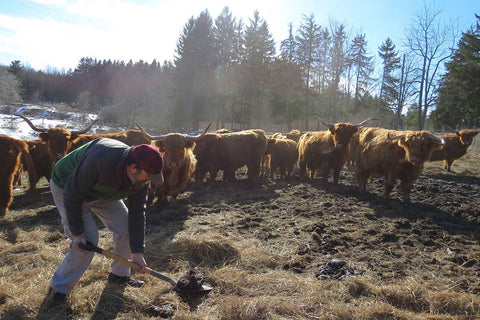
Gathering materials for Cross of Cong research project at Locustbrea Farm in Alfred, NY

Gathering some "materials" for the project.

I will be traveling to Ireland this spring to meet with curators at the National Museum in Dublin. The quest relates to an experimental project that will reproduce a lost part from the legendary 12th century Cross of Cong. I have been making Celtic crosses as jewelry for my entire career. Usually I make a special effort to create new cross designs during the Lenten season leading up to Easter. This year I will also copy a very old one. It just happens that the timeline for this project falls during Lent.

The Cross of Cong was commissioned by King Turlough O'Connor as a reliquary for a fragment of the True Cross that was brought to Ireland in 1123 A.D.

The missing panel on the Cross of Cong

The missing panel on the Cross of Cong.

The project was suggested by Dr. Griffin Murray, one of Ireland's leading experts on medieval Celtic metalwork. Murray has devoted many years to the study of the Cross of Cong, resulting in a book which is a complete and definitive report on this Celtic masterpiece. One aspect of the cross which Murray did not delve into in any great detail is the method by which the intricate bronze decorative panels on the cross were cast. I intend to duplicate a panel which is missing from the Cross of Cong, but also do it in a way that demonstrates the original craftsman's method.

My theory is that the intricate panels of open interlaced animal designs were cast in molds made of a mixture of clay and cow dung. It seems kind of yucky and unsanitary to our modern sensibilities, but that mixture is a remarkable material with a long history of use from everything from plastering walls to casting metal.

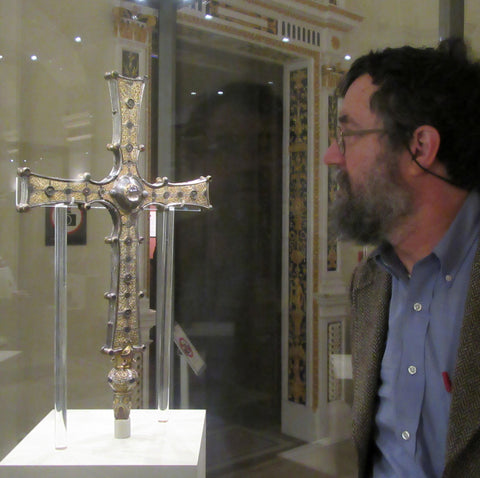
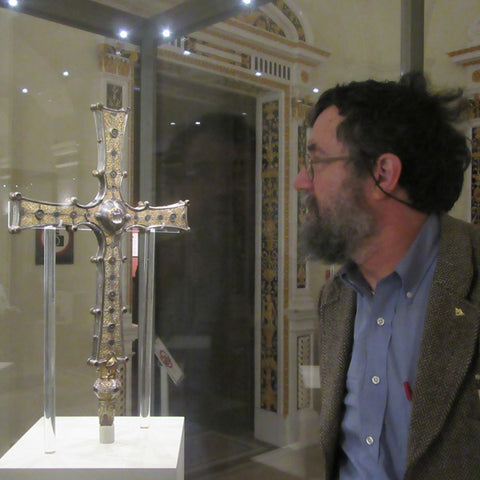
Stephen Walker studying the Cross of Cong at the National Museum of Ireland, January 2016

Stephen Walker studying the Cross of Cong at the National Museum of Ireland, January 2016.

If my effort is successful, after Easter I will make the trip to Ireland to compare my facsimile to the original and have it photographed in place. Then I will make another trip to make a presentation to the International Insular Art Conference, a gathering of Celtic art scholars, archaeologists and museum curators, in Glasgow, Scotland in July 2017.

I really love these old Celtic masterpieces and enjoy the opportunity to work on some of the mysteries about how they were made. The curators and art historians that study these things have been wonderfully supportive of my projects. I have been able to establish something of a reputation at some earlier Insular Art conferences by similar presentations of how artistically challenging Celtic metalwork would have been created.

Stephen Walker's replicas of the St. Ninian's Isle Brooches, made in 2011

Replicas of the St. Ninian's Isle Brooches, made in 2011.

In 2011 in York, England, I gave a presentation on the St. Ninian's Isle treasure, 8th century silver brooches found in the Shetland Islands, north of Scotland. Studies of these pieces revealed a long lost method of creating a style of interlace known to archaeologists as kerbschnitt. In 2014 I demonstrated a plausible solution to the problem that had long vexed art historians of how the cylindrical kerbschnitt stem of the 8th century Ardagh Chalice was molded and cast. Both of these presentations involved actually making facsimiles of the ancient pieces.

The Ardagh Chalice - 8th century Celtic masterpiece

The Ardagh Chalice.

Griffin Murray was instrumental in helping me arrange to have the chalice, one of Ireland's most precious and iconic treasures, removed from the showcase at the National Museum so that I could examine it under a microscope. Last year I visited the museum for a preliminary examination of the Cross of Cong in preparation for the current project.

More on Stephen Walker's Research & Celtic Art

Stephen Walker, Celtic art scholar and master jeweler

About Stephen Walker

Stephen Walker has presented his research on medieval Celtic metalwork at International Insular Art Conferences alongside leading scholars, archaeologists, and museum curators. He is co-author of The Modern History of Celtic Jewellery: 1840-1980 and serves on the advisory panel for the George Bain Collection at Groam House Museum, Scotland.

Learn more about Stephen & Susan Walker →

Continue reading

The Walker's Trip to the British Isles

The Walker's Trip to the British Isles

Back to the work bench now after a two week tour of the British Isles. We started out in London, Sue and I, with our sons Donald and Stephen, daughter Maggie and her husband Eric. We had a lovely dinner with a medieval Celtic metalwork expert friend who invited us all to her home.

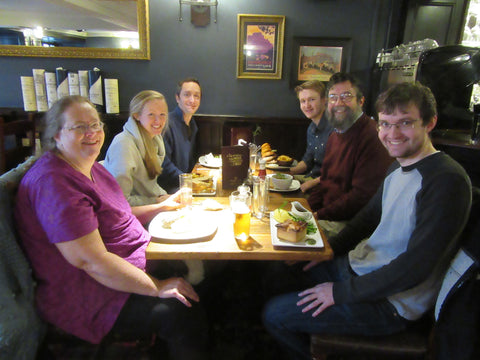
Dinner in Edinburgh

The Walker family from left to right: Sue, Maggie, Eric, Stephen, Steve, and Donald.

The boys spent Saturday at the Chelsea/Everton football match. A great Premier League game that ended in a draw. I spent the weekend at a conference on the Celtic Revival held at the British Museum while the ladies had a leisurely weekend on the town.

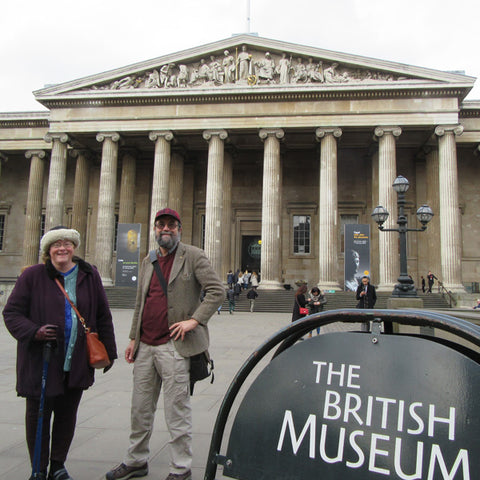
The conference was in conjunction with a feature exhibit at the British Museum called “Celts; art and identity," which was well attended by top scholars and researchers. It was a thrill to me that two of the speakers told me that they had read my book, “The Modern History of Celtic Jewellery”. On Monday we went to the British Museum as a family and saw the exhibit and spent most of the day seeing the many incredible displays that are there.Steve Walker at the British Museum

Steve and Sue Walker at The British Museum.

Later in the week we took the train North to Scotland. There had been some snow earlier in the week, so the Borders were especially picturesque. Getting into Glasgow we stayed with our friends the Caldwells.  Russell Caldwell is a fine Celtic jeweler, whose work was being sold at the British Museum during the Celts exhibit mentioned above.Sue Walker and Russell Caldwell

Sue Walker with Russel Caldwell.

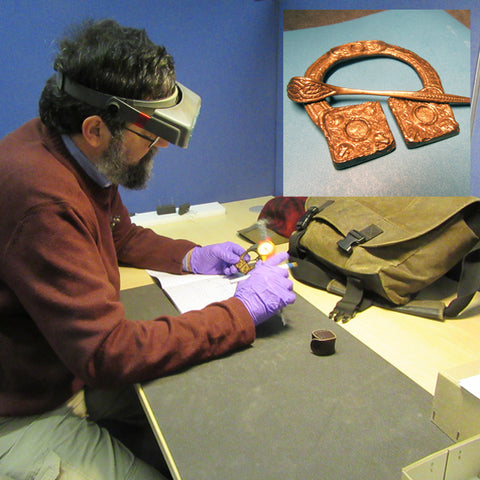
Thursday we all headed to Edinburgh for the day. I had an appointment with the curator at the national Museum of Scotland to examine an electrotype impression of an 8th century Pictish brooch. This brooch was copied by the museum in 1888, but somehow the private owner managed to lose the original! The plan is to make a copy using the original technique of carving a mold in plaster and casting it in silver. This would serve as a demonstration of how these early Celtic smiths worked. The brooch is known as the Banchory Brooch, after the location it was found in the 19th century. My great-grandfather George Watt was born in Banchory, which is in Aberdeenshire.

Banchory Brooch and Steve Walker

Steve Walker examining the Banchory Brooch.

While in Scotland we went to an excellent concert at the Celtic Connections festival. The concert was students and faculty of the Gaelic College on North Uist, Outer Hebrides, singing, playing pipes, fiddles and other instruments.

Maggie and the boys all headed back to the US on the weekend, but not until after we all went to another football match. We saw the Celtics play St. Johnston at Parkhead. (Celtics 3 – Saints 1). Sue and I stayed on for business. We went to a giftware show at the Glasgow SECC and placed a few orders for the shop.

Steve, Sue, Stephen, and Donald Walker at a Celtics game. 

The Caldwell’s served us a supper of haggis, neeps and tatties in honor of Rabbie Burns Day, which is an iconic occasion to be in Scotland. But business called and we had to take leave of their fine hospitality and head to Dublin for another trade show and museum visit. Cross of Cong and Steve Walker

Steve Walker examining the Cross of Cong.

With only three days and two nights in Dublin we managed to shop for more interesting stock for the shop as well as give the 12th century Cross of Cong a good look over, with a tentative plan to do some experimental reproduction work to discover how the openwork interlace panels might have been crafted. We were very pleased to meet some new craftsmen at the trade fair and also to catch up with old friends. We had a delightful dinner at Captain America with silversmith Aidan Breen and plotted a revival of the Modern History of Celtic Jewelry exhibit for Andover this coming March.

Aidan Breen and Sue Walker eating dinner at Captain America.

It was yet another exciting vacation for the family, as well as a successful trip for our business and scholarly pursuits.  It's always so nice to meet up with other Celtic scholars and craftsmen, and the whole family thanks the folks of the British Isles for the warm hospitality extended to us at every stop.  We're looking forward to our next trip abroad, but for now we're happy to be home and back to routine.

Continue reading
  • Previous
  • Page 1 of 2
  • Next