Walker Metalsmiths Blog

Saint Columba - Colum Cille

Saint Columba - Colum Cille

Colum Cille - St. Columba

By Stephen Walker · June 1997

Before giving birth, legend states, Eithne had a dream that she was given a beautiful cloak of many colors. The cloak stretched out from the shore of her native Ireland north to Scotland. She dreamed that the magnificent cloak was taken from her by a young man and this made her very sad. The man returned in her dream and told her not to grieve because the dream meant that she would give birth to a son who would be renowned for his teaching throughout Scotland and Ireland and she should be joyful.

On Thursday 7 December 521 A.D. in County Donegal the boy was born and named Crimthain meaning 'fox' or 'cunning wolf'. As a young boy he was so fond of prayer that he came to be called Colum Cille (Kol-lum-kill), meaning 'Dove of the Church' or Columba in Latin.

His birth was eighty years after the death of St. Patrick. Colum Cille's family was the Royal House of Uí Néill. The Gaelic Irish had heard the Gospels for several generations by this time. Rome had abandoned Britain for more than a century and the Church in Ireland was evolving in relative isolation as Pagan tribes occupied much of the remainder of the Continent with the decline of the Roman Empire. The missions from Celtic Church were about to shine forth the light of the Gospels to Britain and spread the word of God's love to Northern Europe.

Early Life & Education

From childhood he was destined for a religious vocation although it is believed that he was by birth a possible successor to the high King of Ireland. Columba entered the monastery of St. Finian at Movilla where he studied theology and the arts of copying and illuminating sacred texts and became a deacon of the church. His love of words led him to also study with the bard Gemman from whom he learned the traditional poetry and ancient traditions of the Gaels. Several hymns and poems composed by Columba survive to this day.

Columba's love of books and his talent with words are still among his most famous attributes. In Ireland and Scotland today it is a popular folk belief that the Book of Kells was penned by the Saint's own hand. The oldest surviving Irish manuscript, a manuscript of Psalms known as the 'Cathach' is plausibly his work. The Book of Kells, a fantastically illuminated copy of the four Gospels, was actually created around 200 years after Columba's death.

The First Copyright Dispute

A chain of events began when Columba was aged forty that led him to leave Ireland. By this time Columba was a priest and had founded numerous churches and monasteries. He traveled widely and was already an important leader of the Church. These were exciting, optimistic times for a young growing Church. They were however violent times as well and as we shall see. The clergy was no less immune to getting mixed up in political and clan rivalries then than in times since.

The trouble began when Columba secretly made a copy of a book of Psalms, Mosaic Law and the Four Gospels known as St. Martin's Gospel. The book was property of his friend Finian of Movilla. When Finian discovered the copy he angrily demanded the copy be given to him as his rightful property. Columba insisted that the copy did not in any way diminish the original and demanded that High King Diarmid judge legal ownership. The King handed down what may be the first recorded copyright judgment with the words: "To every cow her calf, to every book its copy." and thus upheld Finian's claim against Columba.

There are many legends in Ireland about St. Columba's anger and short temper. Many Irish to this day when cutting peat for fuel will leave a step in the turf bank because of the legend that after falling while crossing one of these banks Columba angrily cursed any peat cutter who would not leave a step so that others could easily cross. Columba's anger went beyond cursing when ownership of the book was judged against him.

The Battle of Cuildrevne & Exile

In a very un-saintly way Columba rallied his family and friends against the King. Historians are skeptical that the book judgment alone is actually what led to the bloodshed. The factions already had strained relations, but popular tradition puts Columba's rejection of the King's ruling as the cause of the Battle of Cuildrevne. The King was defeated but at the cost of thousands slaughtered.

The King appealed to the Church for Columba's excommunication. A synod was held and Columba's friend Brendan of Birr argued for Columba and his confessor and soul friend St. Molaisse advised as penance he accept lifelong exile from Ireland. A remorseful Columba welcomed this punishment and set sail for Scotland to win as many souls for Christ as had been lost in the battle.

Founding of Iona

With twelve companions Columba set sail in 563 A.D. to the north and after stopping at Oransay and Islay, where the shores of Ireland were still visible, he landed on the tiny island of Iona at a shore now known as the 'Port of the Coracle'.

Iona and the surrounding islands of the Hebrides were occupied sparsely by the Picts. Other Irish Gaels prior to Columba and known then as the Scots were establishing settlements in southwest Scotland and created a Kingdom called Dalriada in the area now called Argyll. Columba traveled north to Inverness to visit the Pagan Pictish King Brude. He initially did not convert Brude but he did become friends with him. Brude granted Iona to Columba and his monks and gave him safe passage to preach and conduct his mission. Diplomatically Columba also visited the Irish ruler of Dalriada, Conall mac Comgaill, who also granted Iona to Columba.

To the Dalriad Scots Columba was soon to become their local spiritual authority. When King Conall died in 574 Columba was called upon to ordain Áedán as his successor and is thus the first king in Britain to receive the blessing of the Church as a mandate of legitimate rule.

Mission to the Picts

It is to the Picts in the North that Columba found fresh converts to the Faith. Like the pre-Christian Irish, the Picts followed the religion of the Druids. Columba preached, baptized and ordained among them in much the same way that Patrick ministered to the Irish a century before. For many years, before he was superseded by St. Andrew, he was the patron saint of Scotland. From his base on Iona his little band of missionaries branched out and founded churches and monasteries that soon reached to England and beyond.

So influential did the Abbey at Iona become that soon it was a center for Christian education for Ireland as well. The warrior holy man of the Battle of Cuildrevne preached God's love in his new land. His skill as a diplomat and his respected spiritual authority helped lessen the level of warfare in those violent days. The artistic tradition that is exemplified by the Book of Kells spread to England and Europe. The Book of Kells itself may well have been created on Iona to commemorate the 200th anniversary of St. Columba's death or it may have been completed at Kells in Ireland when Viking raids forced the evacuation of Iona to Kells around the year 800.

The Heron from Ireland

The story of Saint Columba and the Heron tells how the Saint foresaw the visit of a tired and injured "visitor" from Ireland. He sent one of his monks to the western beach to wait for it and an exhausted heron arrived. The monks fed and cared for the bird until it could travel again. Colum Cille himself was an exile from Ireland, so the lonely visitor from his beloved home was of symbolic significance.

Death & Legacy

Columba lived to the age of 76 years. Tradition records that he knew that he was soon going to die and that he wanted to leave this world at Eastertide. He reconsidered since he did not want to make the feast a time of mourning for his brethren and waited a little longer. On his last day he was carried to the fields where the monks were working and blessed the crops. An old white horse which had carried the brothers' milk for many years approached him and rested his head on Columba's shoulder and was seen to weep tears. When he returned to his cell the Saint took up his pen and worked at copying Psalm 34 and stopped at the tenth verse, "but those who seek the Lord lack no good thing", and stated that someone else would have to finish it. He died at the altar of his church at the midnight service. His feast day marks his passage to heaven on the 9th of June 597.

The Celtic Church of Columba's day was not as divided as the church was in future generations. The Celtic and British Church was independent of Rome due to its isolation and separate development. The year of Columba's death, 597, was the same year that Augustine was sent by the Pope to bring British Christians under the authority of Rome. Traces of the distinctly Celtic interpretation of the faith that took root in those early days survive in the heritage of the Catholic, the Anglican and the Church of Scotland. The Church of Scotland is of course the progenitor of the Presbyterian Church.

A Christian community has rebuilt the Abbey on Iona and it is once more a center of worship, study and pilgrimage.

Explore Celtic Christian Heritage

Stephen Walker, Celtic art scholar and master jeweler

About Stephen Walker

Stephen Walker is co-author of The Modern History of Celtic Jewellery: 1840-1980 and serves on the advisory panel for the George Bain Collection at Groam House Museum, Scotland. He has been handcrafting Celtic crosses and jewelry in Andover, NY since 1984.

Learn more about Stephen & Susan Walker →

Continue reading

History of the Luckenbooth Brooch

History of the Luckenbooth Brooch

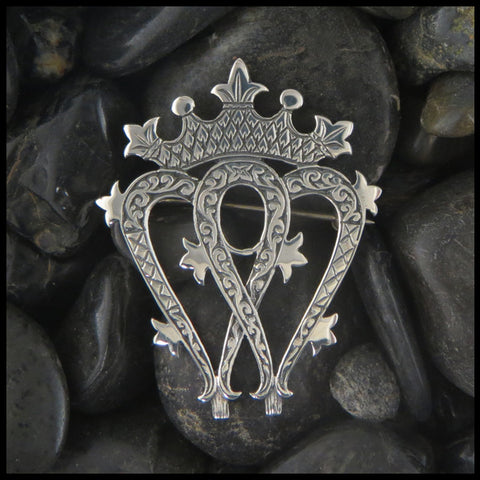
The Luckenbooth brooch gains its name from the “locked booths” that sold trifles along the Royal Mile near Saint Giles Cathedral in High Street, Edinburgh. In its simplest form it is a single heart shape with an open center that works with a buckle pin like an annular brooch. The heart and crown motifs are part of the same 17th century fashion trends that resulted in the Claddagh ring design in Ireland. Two hearts intertwined; with and without crowns, as well as various abstractions and embellishments give this quite simple type of brooch many delightful forms.

                                              Dainty Luckenbooth Brooch.


Quite commonly given as a love token or betrothal gift, folklore also invests the Luckenbooth brooch with talismanic value for protection against evil-eye and for nursing mothers to avoid witches stealing their milk or harming their babies. Legend associates the Luckenbooth brooch with Mary Queen of Scots (1542-1587). The form with two hearts and crown can be read as a romantic abstraction of the letter “M” in a royal monogram. Surprisingly, silver Luckenbooth brooches were a popular trade item with American Indians in the 18th century, especially the Iroquois Nations. The design remains a traditional jewelry accessory and is even called “Luckenbooth” by contemporary Native-Americans.

                                               Ornate Luckenbooth Brooch.


The Luckenbooth brooch has been a self-consciously Scottish form of jewellery since the 19th century. The form was adapted to pebble jewellery in Victorian times, as well as being a regular feature in the ranges of most Scottish manufacturing jewellers who worked for the Highland outfitter and tourist trades. 

From The Modern History of Celtic jewellery:1840-1980.  By Stephen Walker (Author) , Aidan Breen (Author) , Tara Kelly (Author) , E. Mairi MacArthur (Author)


Continue reading

The Modern History of Celtic Jewellery: 1840-1980

The Modern History of Celtic Jewellery: 1840-1980

📚 Stephen Walker is co-author of the definitive book on this subject — bringing scholarly expertise to every piece we create.

From the recovery after the Irish Potato Famine in the 1840s to the booming Celtic Tiger of the 1990s, a revival of the ancient traditions of Celtic jewelry has become a part of how the Irish, as well as the Scots, Welsh and other Celts have expressed their cultural identity. Usually the story of this tradition focuses on very old prototypes—the museum pieces turned up by archaeologists or the legend of the original Claddagh ring. In our imagination, we connect the popular Celtic jewelry of today with the distant past. But that link with the ancient style was very much influenced by what others had done in more recent history.

Four Experts, 150 Years of History

The story is told by four authors, each bringing unique expertise to this comprehensive history:

Tara Kelly

Writes of the early Celtic Revival manufacture of facsimiles of medieval Irish metalwork in Victorian Dublin and how that enterprise led historical Celtic jewellery to become iconic symbols of Irish identity.

Mairi MacArthur

Tells the story of Alexander and Euphemia Ritchie who created the foundation for modern Scottish Celtic jewellery on the Isle of Iona in the early 20th century.

Aidan Breen

Himself a pioneer of the late 20th century Celtic Renaissance, recalls his career beginning with an apprenticeship with Dublin silversmiths which trained him in the traditions of the older Celtic Revival.

Stephen Walker

Craftsman and collector, brings the story together as it spans 150 years—from Scottish pebble jewellery to the innovative modern Celtic creations of the Arts and Crafts Movement.

69 color photographs and 29 black and white illustrations
Available on Amazon →

Why History Matters to Our Craft

Understanding the history of Celtic jewelry isn't just academic interest—it directly informs the work we do at Walker Metalsmiths. When Stephen designs a new Celtic cross or trinity knot piece, he draws on decades of research into how these traditions evolved. This scholarly foundation is what separates authentic Celtic jewelry from mass-produced imitations.

The Celtic Revival masters like George Bain and the Ritchies of Iona established the visual language that contemporary Celtic artists like John Urban and Stephen Walker continue today. This unbroken lineage of craft knowledge is what we mean by "Celtic Renaissance."

Experience the Celtic Tradition

Each piece we create carries 150 years of Celtic Revival tradition—informed by scholarship, executed with master craftsmanship.

Shop Celtic Jewelry Meet the Walkers

Explore Celtic History & Symbolism

Stephen Walker, Celtic jewelry historian and artisan

About Stephen Walker

Stephen Walker is co-author of The Modern History of Celtic Jewellery: 1840-1980, serves on the advisory panel for the George Bain Collection at Groam House Museum in Scotland, and has been handcrafting Celtic jewelry in Andover, NY since 1984. His scholarly research directly informs every piece created at Walker Metalsmiths.

Learn more about Stephen & Susan Walker →

Continue reading

In Search of Meaning: Symbolism of Celtic Knotwork and Design

In Search of Meaning: Symbolism of Celtic Knotwork and Design

What Do Celtic Knots Mean?

Often the first question asked about Celtic interlace is "What does it mean?" The assumption is that these designs are a secret language of symbols that could be decoded if we only had the key.

📖 Celtic Interlace Design Series - Part 3

Part 1: Origins of Celtic Knotwork

Part 2: The Continuum of Celtic Interlace

Part 3: In Search of Meaning: Symbolism (You are here)

The Problem of Interpreting Ancient Symbols

When talking about things Celtic we have to remember that things change through time and place. What meaning may or may not have been for the monks that illuminated masterpieces such as the 9th century Book of Kells is not necessarily the same meaning expressed by users of Celtic design in more recent years, but there is a popularly held notion that it is or ought to be.

While it may be reckless speculation to claim a certain symbolic meaning as the original intent of an artist working in the Dark Ages, we should not dismiss that an artist working in our own times intends a symbolic message in the same type of design and that that meaning is valid in context. The problems that occur are a result of there being very little consensus among artists about Celtic symbolism and the perception that the symbolism suggested has been gleaned from an ancient source. The naive believer hopes that the symbolism offered by a modern artist or craftsman is an authentic legacy from the past. The skeptic thinks this is very unlikely and considers it fanciful fakery.

Celtic Art as a Living Tradition

When a creative modern imagination invents meaning for an ancient design, the scholar will predictably scoff. Celtic Art by its nature is a link with the distant past. If we continue to insist on always reaching back 1,200 years to the Book of Kells for our perspective on Celtic Art we ignore the traditions that authenticate the claim that Celtic Art is a living tradition. The Celtic Revival began 150 years ago and in this time the creative use of Celtic design has evolved along with the myth that there is a timeless consistency of what Celtic Art is all about.

What Art Historians Say About Symbolism

The more you study Celtic Art, the less urgent the issue of symbolism becomes. Art historians are consumed with problems of timeline, place of origin and migration of styles and ideas. Artists and designers who work with Celtic themes today are more interested in creative applications and technique. Work with a message is likely to be spelled out in words or conveyed with figurative images or more universally recognized symbols such as crosses, doves or hearts. Yet the most common question from the public about knotwork is, "What does it mean?"

For the contemporary Celtic artist or craftsman, explanation of symbolism can be more of an answer to what may be an awkward question. "Can you show me the knots that means 'love, health or strength'?" What an opportunity for creative marketing! We have absolutely no hard evidence that any such meaning were ever intended by the ancients, but this has not stopped modern designers from attributing such meanings. Art historians have been very shy about even speculating about the possible symbolism of Celtic Interlace. To look for a pat explanation from the scholars is a disappointment. Many go as far as stating that interlace was historically used purely for decoration and that suggestions of any symbolic intent are not supported by credible research.

The Triquetra: A Case Study in Interpretation

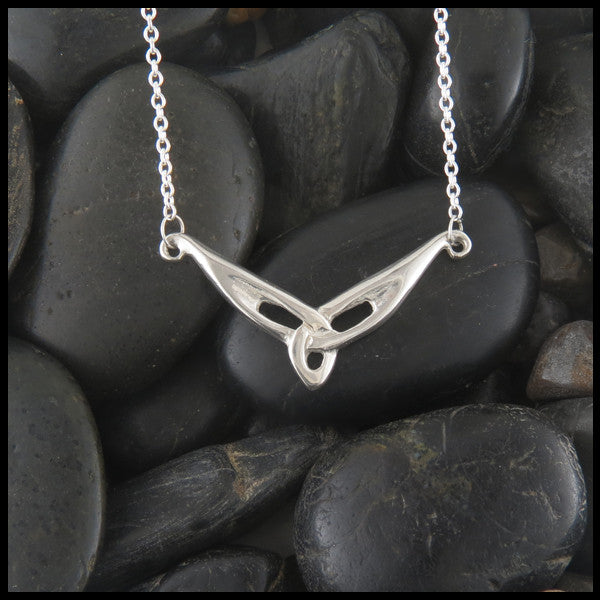
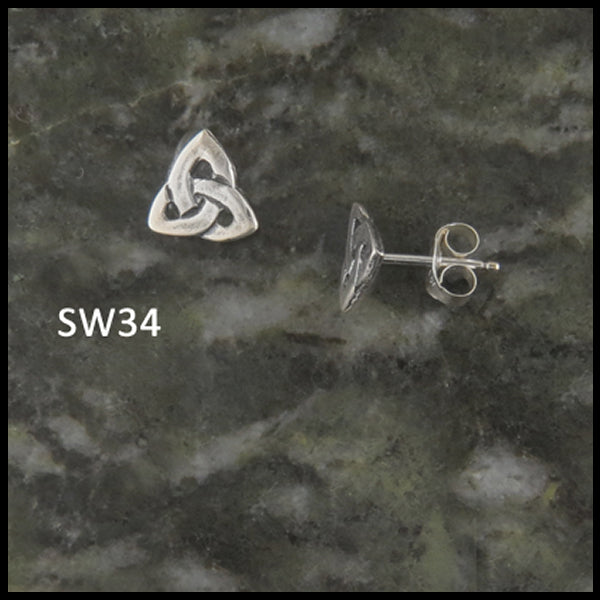
The case of the triquetra or three-fold knot is a good example of the difficulty that one faces when trying to assign specific meaning to Celtic designs. Sacred numbers and the symbolism of numerology offer a promising basis for the interpretation of Early Christian Celtic ornament. The triquetra is an obvious sign of the Holy Trinity. Other knots could represent the four directions, the twelve Apostles and so on. But as important as numbers are in Scripture, legends and poetry, the connection remains elusive and evidence circumstantial.

What the Experts Said

J. Romilly Allen (1903):

"With the exception of the instances at Meigle and at Llanfrynach, in Brecknockshire, the triquetra is used for purely ornamental purposes, and there is not the least foundation for the theory that it is symbolic of the Holy Trinity. If the triquetra knot had ever any symbolical significance at all it was probably in pagan times and in that case it probably had some affinity with the triskele..."

Allen's premise seems to be based on the observation that the triquetra (and other interlace designs) play a decorative role and are not given the prominence of placement that one would assume an important symbol should have.

Françoise Henry (1940):

Regarding a stone slab at Killagtee, Donegal: "This knot stands most probably for the Trinity, and the whole cross seems to be an awkward version of the Chi-Rho..."

Allen opines that the triquetra is not a Trinity symbol and casts doubt that it was used as a symbol at all. Henry suggests that it probably stood for the Trinity, at least in this one case, but leaves the question open. Each of these experts were leading authorities in their day and neither gives a definite answer to the question of meaning for the knot that should be the easiest to explain.

The Triquetra in Modern Times

When the triquetra stands alone it certainly looks like a symbol, but in early Christian Celtic venues it rarely does. If the triquetra had formerly been used as it is now, we would have no reason to doubt its function as a symbol. In modern times it has been customary to display designs alone that would have been details in older work. These stand-alone details are frequently seen in books about Celtic Art or on modern day Celtic craft objects.

When a single knot appears alone, as say a pendant that is a single triquetra, it seems as if it must be a symbol. Given the Celt's penchant for blessings and invoking the Holy Trinity, the meaning of the triquetra seems more obvious than any other knotwork. The triquetra is quite commonly called the "Trinity knot" and has been consciously used as a Christian symbol during the 150 years of the Celtic Revival. In recent decades it has also been appropriated as an emblem of the "Triple Goddess" by Pagan revivalists. When someone plucked the triquetra out of antiquity and it stood alone in modern times, this was a creative act and the triquetra was no longer just a pretty space filler.

From International Style to Symbol of Identity

Celtic interlace, or attempts at something that looked like it have been made in every century since the Insular style first emerged in the 7th century. At first interlace was being used to decorate Gospels and symbols of Christian faith such as crosses. Religious and secular use of Celtic Art cannot be seen as expressing any national identity prior to the Norman invasion, especially when it is recognized that at this time several peoples—the Irish, the Picts, the Scots of Dal Riada and the Northumbrians—all had artists that excelled in the style.

The nearest neighbors, the southern Anglo-Saxons, the Welsh and many continental religious communities also produced manuscript decorations in the Celtic or "Hiberno-Saxon" tradition. During the "Golden Age" of Celtic art, 7th to 10th centuries, the style and vocabulary of ornament was an international style throughout the region.

Decline and Survival

With the Norman invasions of Britain and Ireland, Celtic design went into decline. Traditions of using interlace designs lingered in some of the more Gaelic areas. It eventually became a way of identifying with the older Gaelic cultural tradition in the face of advancing Anglo-Norman power.

In the Hebrides and West Highlands, the Lords of the Isles and other Gaelic aristocrats continued to patronize the carving of interlace decorated monuments as well as portable objects. By the 15th century there was a self-conscious preservation of an older social order with a distinctly Celtic heritage. Knotwork became to a certain extent an emblem of political and cultural identity. Rustic and sometimes very crude attempts at carving knotwork on grave monuments speak of the desire of impoverished but proud Highlanders to imitate the glory of their ancestors.

The Celtic Revival: 19th Century Renaissance

Weapons and jewellery associated with the Jacobite movement continued to be decorated with knotwork until 1745. At this point the longest gap appears in the continuity of use. Little, if any knotwork was produced from then until the dawn of the Celtic Revival in the mid-1800's.

Ireland

The Celtic Revival in Ireland began as an effort to restore a sense of pride in a distinct Irish culture. Objects such as the Book of Kells and the Tara Brooch were concrete evidence that the Irish had once been a sophisticated, civilized society. The re-use of Celtic designs began as imitations of historical jewellery and monuments that were used as an affirmation of Irish identity and an association with the glory of past times.

Scotland

During the same time in Scotland, Queen Victoria was an enthusiastic promoter of a romantic vision of Scottish national identity. Celtic design was slow to catch on in Scotland. Victorian dirks were carved with thistles and clan emblems, rather than the traditional interlace. It was later in the 19th century that knotwork began to add ornaments to tartan. The trend towards Celtic design on Highland dress accessories have slowly but steadily increased to the present.

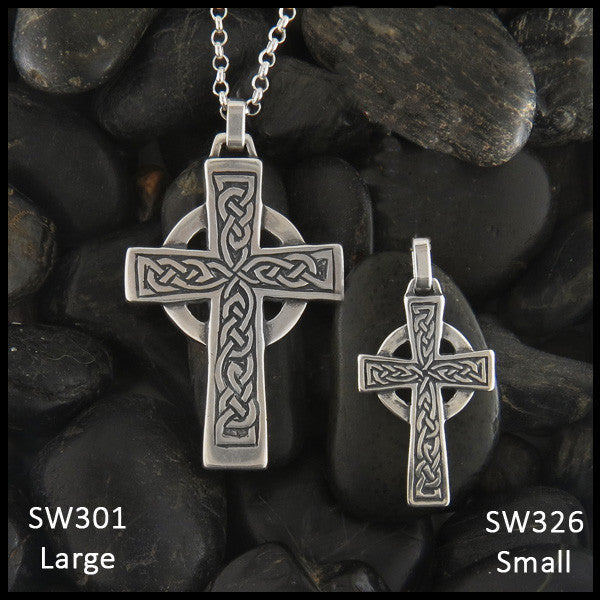
The earliest Celtic Revival monuments are from the 1860's. In both Scotland and Ireland monumental carving was and remains the most conspicuous uses of Celtic design. Many of the most elaborate earlier monuments of the Celtic Revival are the gravestones of priests. Recognition of the legacy of the Celtic Church was being expressed with the creation of new "High Crosses" both as public monuments and as grave markers.

Common Modern Interpretations

The "Endless Path" Interpretation

A standard answer to the meaning of knotwork question offered by many craftsmen and artists in recent times is that Celtic knots are endless paths and so represent eternity or continuum. The Scottish art teacher George Bain published the book Celtic Art; The Methods of Construction in 1951. This book became a standard reference and source book especially after its re-release in 1971.

In it the author made a great deal of the single continuous path that is laid out in many ancient knotwork panels. This observation leads quite nicely to ideas about the "circle of life" or "never ending… love, faith, loyalty, what ever you want." Many ancient Celtic knots are not a single path, but several closed paths that are linked or woven together. These can be seen as metaphors for the interwoven-ness of life, or linking knots are frequently referred to as "love knots."

Why would it be that continuum would be such an important concept that an elaborate symbology as knotwork would be contrived? In modern times those who maintain an interest in Celtic things, be it Celtic music, dance, religion, folklore or history, may relate to the idea of continuum in their desire to affirm and preserve a culture they value, nobly surviving despite centuries on the margins of European mainstream.

Among Celtic Diaspora, those emigrants and their descendants whose interest in their roots have become a passion are especially likely to relate to a message of continuum as they strive to maintain an identity with their heritage in the multi-cultural melting pot of the New World. If the modern motive for creating or viewing Celtic knotwork involves a sense of heritage, the message of continuum seems to work.

The Enduring Mystery

The "secret language" mystique of Celtic art is what makes it so very fascinating to many who look to it today for significance. Many myths carry a lesson about truth. The myth that every miniscule detail of Celtic art is symbolic, like all genuine folklore, has many variations. The various beliefs that the symbolism is now lost or perhaps dimly remembered or optimistically preserved by a few who have kept and studied the old traditions, cloaks Celtic art in an exciting veil of mystery.

Wear the Mystery: Celtic Knotwork Jewelry

Whether you believe in ancient meanings or modern interpretations, Celtic knotwork connects you to a living tradition spanning 1,400 years. Each piece handcrafted in sterling silver and 14K gold.

Trinity Knot
Three-fold symbolism
Endless Knots
Eternity & continuum
Celtic Crosses
Faith & heritage
Shop Celtic Jewelry → Shop Trinity Knots →

Explore More Celtic History & Symbolism

Stephen Walker

About the Author

Stephen Walker

Stephen Walker is the founder and Master Craftsman at Walker Metalsmiths. With decades of study in Celtic art history and hands-on experience creating traditional designs, Stephen brings both scholarly knowledge and artistic practice to understanding Celtic symbolism.

Note from the author: My thanks to members of Celtic_Art @ eGroups for their discussion and debate of the issues of meaning and symbolism during January 2001. The chance to kick around these ideas with a cross-section of imaginative, passionate and knowledgeable contemporary Celtic artists and designers was of immense value.

Learn more about Stephen & Susan Walker →
Read Stephen's book: "The Modern History of Celtic Jewelry" →

Continue reading