

“Lost Art” Revealed by Jeweler at Celtic Art Conference in Ireland
American Celtic Jeweler Stephen Walker presented a demonstration and discussion at an international gathering of Celtic Art experts at the National University of Ireland in Galway on July 19, 2014. Walker's topic is the Ardagh Chalice, an extremely elaborate bit of metalwork from 8th century Ireland, now displayed at the National Museum of Ireland.
Solving the Mystery of Chip-Carved Celtic Decoration
The chip-carved decoration of the stem of this masterpiece has long been a puzzle to both historical researchers and modern craftsmen. Walker developed a theory about how the mold was made to cast the intricate, deeply carved interlace with 396 crossings in an area just under 13 square centimeters. Walker then hand carved a similar mold and cast a replica in bronze using only simple tools and materials that would have been available to early medieval Celtic craftsmen.

Stephen Walker presenting his Ardagh Chalice research at the International Insular Art Conference in Galway, Ireland
The International Insular Art Conference
The International Insular Art Conference is held at different locations every three to five years. This year the thirty nine presenters include historians, curators and archaeologists from Trinity College, The National Museums of Ireland and Scotland as well as other Irish and international scholars.

Conference attendees examining Stephen's hand-carved mold and bronze casting
Three Theories About Cast Chip-Carving (Kerbschnitt)
Walker discussed the three most common theories about cast chip-carving, or "kerbschnitt" as scholars often refer to it:
- Clay impressions — taking clay impressions from models carved in another material using the same chip carving technique used by wood craftsmen
- Lost-wax casting — creating a wax model that is melted away during the casting process
- Direct carving — directly carving in the metal after the shape is cast
Walker showed how each of these methods were used for some medieval pieces but that a more direct technique of carving the mold rather than first making a positive model is a simpler and more plausible explanation for most of the cast kerbschnitt material.

Detail of Stephen's hand-carved mold replicating the Ardagh Chalice stem decoration
A Truly "Lost Art" from Celtic Ireland's Golden Age
The interlace and spiral designs created in this manner were a central feature of Celtic metalwork during the "Golden Age" from the 7th to the 10th centuries. Walker explains:
"There was a lull in the production of high status metalwork after the Viking raids of the 9th century. By the 11th century the kerbschnitt technique was replaced by other methods of rendering Celtic ornament. So this really is a 'lost art' that went out of practice over a thousand years ago."
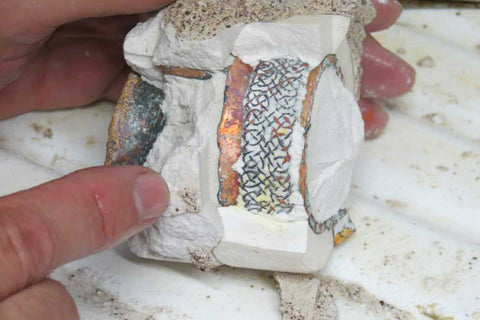
Bronze casting from Stephen's hand-carved mold — proof that direct mold carving was a viable medieval technique
Bringing Ancient Techniques to Modern Celtic Jewelry
Walker Metalsmiths has stores in Andover, NY and Fairport, NY. Four full time craftsmen are employed creating their own in-house line of gold and silver contemporary and traditional Celtic jewelry. They also offer the work of several of the finest Celtic jewelers from Ireland and Scotland.
Stephen's research into authentic Celtic metalworking techniques informs every piece created at Walker Metalsmiths — ensuring that our Celtic pendants, rings, and crosses honor the true heritage of Celtic design.
Authentic Celtic Jewelry Crafted with Historical Knowledge
Every piece at Walker Metalsmiths is informed by decades of research into authentic Celtic art and traditional metalworking techniques.
Browse Celtic Jewelry → Meet Stephen Walker →Explore More Celtic Art Research & Craftsmanship
- Stephen's Published Ardagh Chalice Research — The full academic paper on this groundbreaking research
- Cross of Cong Research Project — Another deep dive into medieval Irish metalwork
- The Authenticity of Celtic Art — Why authentic design matters in Celtic jewelry
- Celtic Art: The Local Tradition — Celtic art heritage in Andover, NY
- Zoomorphic Symbolism in Celtic Art — Understanding Celtic animal designs

About the Author
Stephen Walker has been handcrafting Celtic jewelry in Andover, NY since 1984. A recognized scholar of Celtic art, Stephen has presented his research at international academic conferences and published papers on authentic Celtic metalworking techniques from Ireland's Golden Age.
Leave a comment